Wednesday, 5 April 2017

Act As and Impersonate in OBIEE


Sometimes, there will be a scenario like , Developer has to work with another developer credentials when the other developer is on leave. Password sharing is a aside( This is very Bad idea).
In this case, OBIEE Supports two methods for user to access the system as if they were another Impersonation and Act As.

This article just providing the difference between Impersonation and Act As , as So many blogs have detailed on this already.

Impersonation:

Impersonation is where a super user can login into obiee as another user without needing their password. It is achieved from front endby specifying URL. specifying,

  • The superusers login name and password (NQUser and NQPasword)
  • The login ID of the user to impersonate (Impersonate)
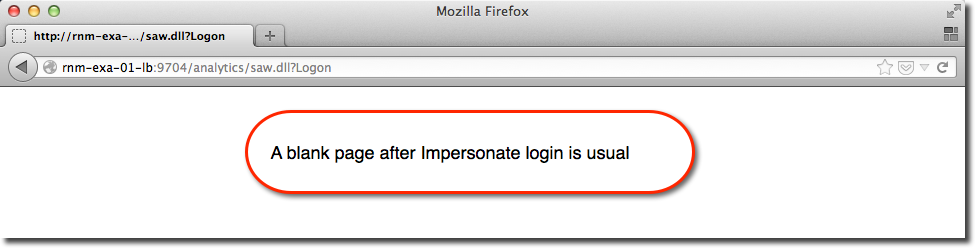
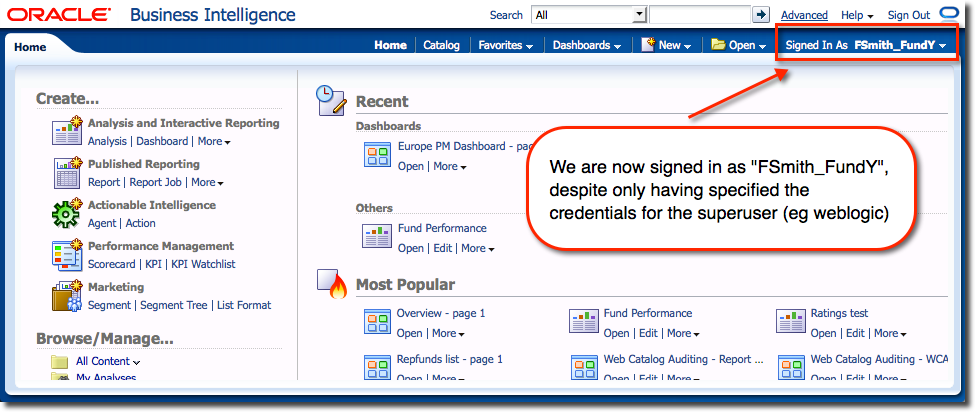
The server will return a blank page to this request, but you can then submit another URL to OBIEE (eg the OBIEE catalog page or home page) and will already be authenticated as the Impersonate user - without having specified their password.


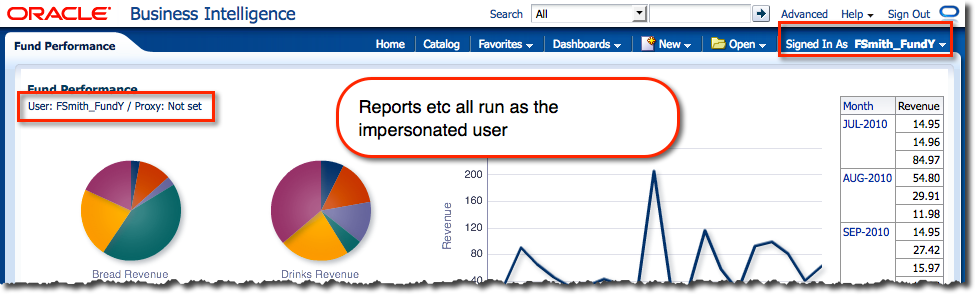
From here you can view the system as they would, and carry out whatever support or troubleshooting tasks are required.
 

Caution :  Impersonation is disabled by default, even for the weblogic Administrator user, and it is a good idea to leave it that way. If you do decide to enable it, make sure that the user to whom you grant it has a secure password that is not shared or known by anyone other than the account owner. Also, you will see from the illustration above that the password is submitted in plain text which is not good from a security point of view. It could be "sniffed" along the way, or more easily, extracted from the browser history.

Act As:

Act As is a very similar concept to Impersonation (allow one user to access OBIEE as if they were another), Act As is much more controlled in how it grants the rights. Act As requires you to specify a list of users who may use the functionality (“Proxy users”), and for each of the proxy users, a list of users (“Target users”) who they may access OBIEE as.

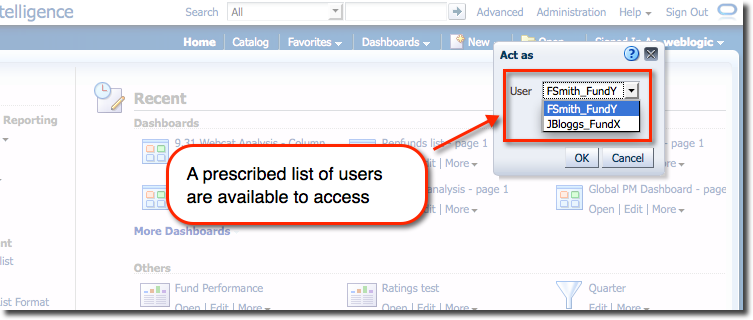
Act As functionality is accessed from the user dropdown menu :
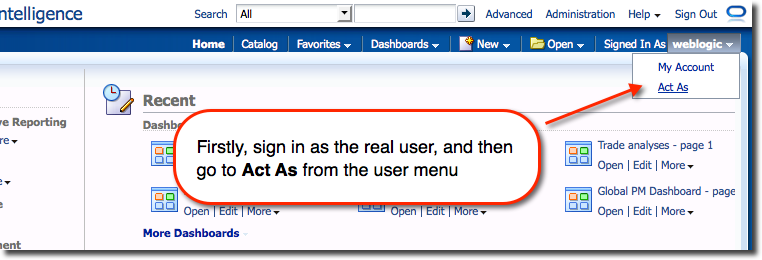
 

From where a list of users that the logged-in user (“proxy user”) has been configured to be able to access is shown :
 

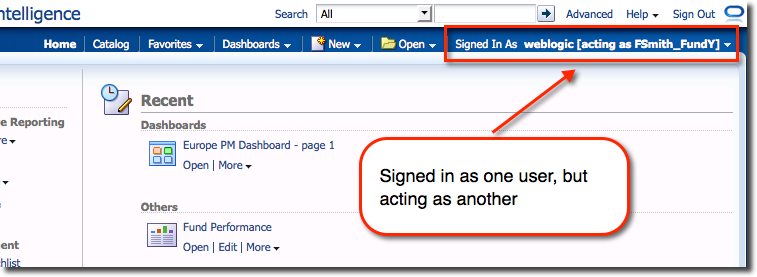
Selecting a user switches straight to it:
 

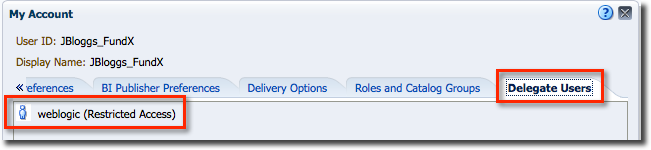
In addition to this fine grained specification of user:user relationships, you can specify the level of access a Proxy user gets – full, or read-only. Target users (those others can Act As) can see from their account page who exactly has access to their account, and what level of access.


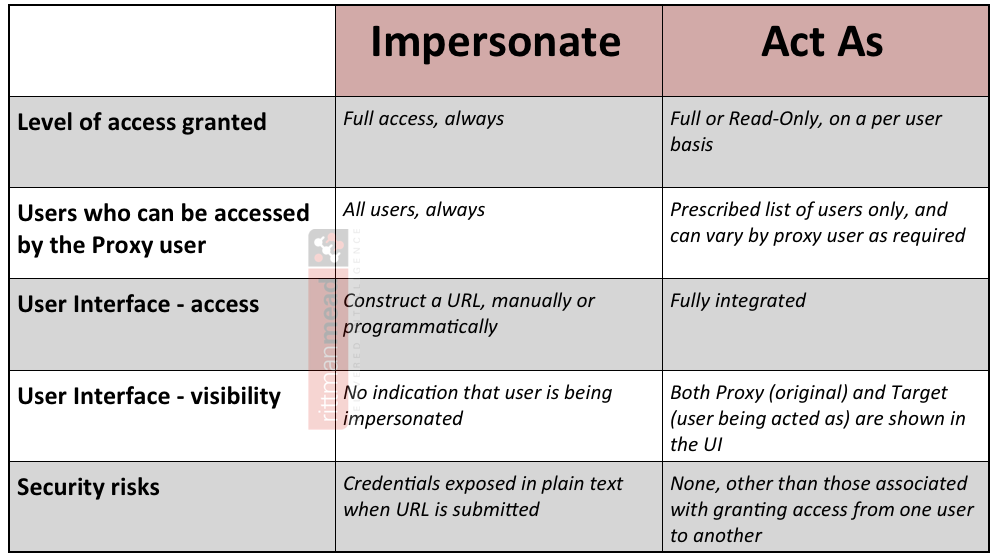
Difference:
 

Tuesday, 20 August 2013

Chronological Key


Chronological Key -
              Chronological Key is a key which uniquely identifies the data at a particular level. Mostly used in Time Dimensions.

Surrogate Key -
              Surrogate Key is an artificial key, it is used as a substitution for natural primary key in order to provide data consistency.

Tuesday, 9 October 2012

Characteristics of Data Warehouse:

 A common way of introducing data warehousing is to refer to the characteristics of a data warehouse as set forth by William Inmon:

Subject Oriented

Integrated

Non Volatile

Time Variant

Subject Oriented : 

The ability to define a data warehouse by subject manner.
For ex: To learn more about your company's sales data, you can build a warehouse that concentrates on sales. Using this warehouse, you can answer questions like "Who was our best customer for this item last year?" This ability to define a data warehouse by subject matter, sales in this case, makes the data warehouse subject oriented.

Integrated : 

Integration is closely related to subject orientation. Data warehouses must keep the data from different sources into a consistent format.They must resolve such problems as naming conflicts and inconsistencies among units of measure. When they achieve this, they are said to be integrated.

Non Volatile :

It means, Data, once it entered into the data warehouse, it should not be changed. This is logical because the purpose of a warehouse is to enable you to analyze what has occurred.

Time Variant :

In order to discover trends in business, analysts need large amounts of data. This is very much in contrast to OLTP systems, where performance requirements demand that historical data be moved to an archive. A data warehouse's focus on change over time is what is meant by the term time variant.


Monday, 8 October 2012

DataWareHouse

Data Warehouse:

A data warehouse is a relational database that is designed for query and analysis rather than for transaction processing. It usually contains historical data derived from transactional data,but it can include data from other data sources. It separates analysis work load from transaction workload and enables an organisation to consolidate data from several sources.